Measuring and Marking: Rulers and Grids vs. Curves and Tape Measures
PART 2: Quilting vs. Garment Sewing: Measuring & Marking Tools
Acrylic grid rulers, flexible tape measures, heat erasable markers, French curves… If you've ever wondered why a quilter and a dressmaker seem to reach for completely different tools even when doing what looks like the same job, this is the post that explains it. Measuring in quilting is about grids, angles, and hitting that exact ¼" seam every single time. Your rulers are rigid, transparent, and covered in lines that guide both your measurements and your cuts in one move.
Measuring in garment sewing is about curves, the body, and a flexible tape measure that goes around a waist, over a shoulder, down the length of an arm. The marking tools follow the similar logic: quilters mark sparingly and precisely; garment sewists mark generously and in multiple places. Same craft family, different toolkits, and once you understand why, the tools start to make perfect sense.
This is Part 2 of our series comparing the quilting and garment sewing toolkit. If you missed Part 1 on cutting tools, you can catch up here: Part 1 of the Series: Quilting vs. Garment Sewing
The Quilting Side
Tools: Quilting Rulers - Cutting Mat - Seam Guide Ruler - Fabric Markers
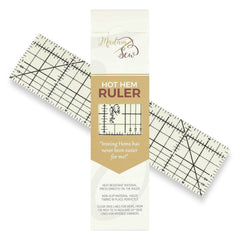
Quilters are all about straight lines and precise angles. Quilt rulers are a big thing in quilting and a lot of them are purely used as a cutting aid, as discussed in the previous post in these series. Acrylic quilting rulers, printed with grid lines in ⅛" increments, are essential. They come in a very large array of sizes. A 6" x 24" ruler handles most strip-cutting needs. Square rulers (from tiny 2½" to large 12½" or bigger) are critical for squaring up blocks. Specialty rulers exist for cutting 60-degree triangles, flying geese units, and all kinds of specific shapes. The quarter-inch patchwork ruler measures quarter inch lines on your patchwork pieces or quilts when you are making half-square triangles, hourglass, combination, flying geese or snowball units. With a creative shape cut ruler (that has cutting slots every half an inch), you can cut your own jelly roll strip sets or strips in various widths easily.
Madam Sew's acrylic quilting rulers are clear, grippy and printed with precise grid lines so your cuts stay accurate and your ruler stays put. Good basics that will last you a long time!
A dedicated quarter-inch patchwork ruler takes the guesswork out of seam allowances when working on half-square triangles or flying geese, and keeps your pieces consistent from first cut to last.
With cutting slots every half inch, the creative shape cut ruler lets you slice your own jelly roll strips or cut fabric in a variety of widths, without measuring each time.
A cutting mat serves as a measuring tool too in quilting. Its printed grid helps you align fabric and position your ruler to execute your cuts precisely.
A rotating cutting mat takes that a step further. Spin it to reposition your fabric without disturbing your layout, so you can cut from any angle without getting up or shifting everything around.
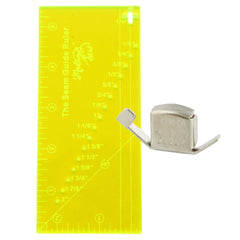
A seam guide ruler is another tool that is loved by quilters. It helps you set and verify your seam allowance accurately on your machine, which is critical when you need to be spot-on every single time.
If seam allowance accuracy is something you struggle with or simply don't want to leave to chance, the Madam Sew seam guide ruler is worth having at your machine.
Quilters use fabric markers mostly in the quilting phase. Erasable fabric markers that draw very thin, accurate lines on top of your quilt sandwich can guide you when stitching straight-line quilting, crosshatch patterns, or any custom design. A lot of quilters use heat-erasable fabric markers or chalk markers with a little chalk wheel for this purpose, but there are other marking tools on the market. I compared a couple of them in this article about temporary fabric markers for sewing and quilting.
The Garment Side
Tools: Flexible Rulers - Seam Gauges - Curved Rulers - Temporary Fabric Markers
Garment sewists depend more on flexible tape measures. They wrap around the body's curves, making them essential for taking accurate body measurements and checking garment fit. A seam gauge with a sliding guide or a smaller gauge one with set measurements can help to quickly check or mark seam allowances and hem depths. Specifically for body measurements, a body self measuring tape is a handy little tool if you don’t have an extra pair of hands in the room. On my craft table I also added an adhesive ruler strip so I can quickly check fabric or other material’s lengths. This ruler is perfect for at-a-glance measurements.
A good flexible tape measure is one of those tools you'll reach for constantly to take body measurements or check garment fit.
If you're often measuring alone, a body self measuring tape makes the whole process so much easier, no second pair of hands needed.
An adhesive ruler strip on your craft table means measurements are always right there when you need them.
You'll also find an assortment of curved rulers in a tailor's or seamstress' toolkit that doesn't exist in quilting: the French curve for drawing smooth armholes and necklines, the hip curve for shaping side seams and hemlines, and the L-square or set square for establishing straight grain and right angles when drafting patterns.
If you copy, draft or alter patterns (and many garment sewists do), you'll also need pattern paper, a clear gridded ruler, and possibly a flexible curve ruler. Some sewists even invest in a grading ruler for sizing patterns up or down. Pattern weights also come in handy here.
For marking, garment sewists use erasable fabric markers like tailor's tacks, chalk markers, wax pencils, and disappearing-ink markers more frequently than quilters do because garment construction involves more marking directly onto the fabric. You mark pattern pieces, seam allowances, hem lines, darts, pleats, the position of a pocket, etc. Measuring and cutting, like you do in quilting, without marking, is more rare in sewing. Pattern drafters also use tracing wheels and carbon paper for transferring darts and notch marks.
The marks of heat erasable fabric markers vanish with the heat of an iron, which fits naturally into your workflow since you're pressing seams anyway.
A precision chalk marker with a dosing wheel is a garment sewist's reliable everyday companion, easy to see on fabric and simple to remove once your seam is sewn.
Where They Overlap
Tools: Seam Gauges - Small Ruler
Although they use very different rulers overall, both crafts use seam gauges, the small metal rulers with or without a sliding marker for checking seam allowances and/or hem depths. A good, accurate, small ruler of some kind is non-negotiable on both sides. And for the sewists that started using a rotary cutter, a standard quilt ruler is not optional. You can't cut accurately with a tape measure or a flexible ruler sewing ruler.
Measuring Tools Takeaway
The difference between quilting rulers and sewing rulers really comes down to what you're building. Quilting rulers are about repeatable precision on a flat surface. It’s about grids, angles, and strips cut to the exact same width every time. Sewing rulers are about the body, the curve, the hem. A French curve ruler might look intimidating to garment sewing beginners, but once you've used one to redraw a neckline or smooth out an armhole, you won't want to be without it. The same goes for a body measuring tape for sewing at home, a small tool with a big impact when you're trying to get a good fit on your own. And whichever side of the craft you're on, a seam gauge and a good fabric marker are two essential tools for both quilting and sewing.
Up next in Part 3: the sewing machine, same machine, but very different demands depending on what you're making.
Happy measuring!
An
Blogging for Madam Sew