Hemming Problems Solved: 5 Common Issues and the Tools That Fix Them
After 15 minutes of marking, pinning, measuring, and re-measuring, and ironing, you finally stitch your hem. It looks a bit wonky, you take it to the ironing board again, press it, and... it doesn’t look straight. The fabric puckered. The topstitching looks wobbly. And you spent half an hour on something that should have taken 10 minutes.
Here's the truth: The problem isn't your skill level. Maybe you're trying to achieve professional results with basic tools that weren't designed for precision hemming. Professional seamstresses don't all have magic hands, yes, they have experience but also, the right tools that make accuracy easy, speed up the process, and eliminate frustration.
In this guide, we'll show you exactly which tools solve which hemming problems, backed by sewist reviews, forum discussions, and expert recommendations. You'll learn what tools to reach for, and what to include in a perfect hemming toolkit based on what you actually sew.
These are the five hemming issues I’ve identified. I’ll dive into each one in depth.
────୨ৎ────
PROBLEM #1: Uneven Hem Allowances (Measuring Inconsistency)
Inconsistent hem depth is the number one frustration mentioned in a lot of hemming discussions, with beginners three times more likely to struggle with this than experienced sewists.
The Frustration: You fold up your hem, measure 1½", pin it, and start sewing around the garment. Halfway through, you realize the hem is 1¾" in some places, 1¼" in others. By the time you finish stitching, the hemline looks all drunk.
Why This Happens:
- It is almost inevitable that your measuring tape shifts a bit when you work, especially around curved edges
- It is difficult to hold consistent depth while pinning
- Fabric stretches or compresses a bit during handling, some fabrics more than others
- It can be hard to see measurements on dark fabrics or in dimly lit rooms.
The Solution: A Hem Gauge Plus a Fabric Marking Tool
Hem gauges create a consistent, repeatable measurement that shifts less plus they don’t require mental math. They let you mark or fold fabric to an exact depth in seconds. Choose a fabric marker with accurate marking and easy mark removal, like a heat erasable fabric marking pen for example.
Basic Measuring Gauge
This is a small metal gauge that has 14 commonly-used measurements in one tool, ranging from 1/8 to 2 inches.
- Handy for marking seam allowances and hem distances, plus checking small measurements when quilting or sewing
- Budget conscious option, low cost and it lasts forever
Sliding Measuring Gauge
This is a metal gauge with a sliding marker that you can set to the distance you are working with, you can quickly mark and move the ruler and check if marks or folds are accurate.
- Best for those who hem mostly straight edges
- Budget conscious option, low cost and it lasts forever
- Works for 95% of hemming tasks
- This is the number one hemming tool, a sewing basic
- “Simple but effective”
A Cardboard Template
You can make a gauge yourself with a piece of cardboard to help you keep a consistent hem when marking or ironing the folds. This is a super budget DIY option.
- How to make it: cut a cardboard strip to the desired hem depth. You can make it in multiple sizes (¼”, ⅜”, ½”, ⅝”, ¾”, …)
- Use it as a folding guide for a specific project or the depth you use regularly
- Very budget friendly but won’t last very long
Adjustable Hem/Skirt Chalk Marker
This is a hem marking tool designed for hemming skirts, dresses or curtains. It ensures a perfectly level line, crucial for circular skirts and dresses where hems can easily be uneven.
- How it works: You wear the garment, adjust the height of the ruler to your desired hem length, squeeze the rubber bulb to spray chalk onto the fabric,
- It creates a precise, even line all around the skirt or dress so you can iron or pin more easily and more accurately.
- It is a more expensive tool but if you are sewing a lot of dresses and skirts it might be worth the investment.
Quick Win Tip: Whatever gauge you use, mark the hem depth at 4-6 points around the garment first (at seams and between), then pin between these marked points. This prevents cumulative measuring errors.
────୨ৎ────
PROBLEM #2: Fabric Shifting While Pinning and Sewing
'Fabric shifting' or 'layers moving' is mentioned in almost a third of hemming frustration posts, particularly for slippery fabrics (more than 50% of silk/satin hemming discussions) and thick materials (half of the denim hemming discussions).
The Frustration: You pin your hem carefully, start sewing, and watch helplessly as the fabric shifts under the presser foot. The hem you worked so hard to measure is now wavy, uneven, and has to be ripped out. Again.
Why This Happens:
- Pins don't hold fabric layers firmly enough
- Presser foot pressure pushes fabric in different directions
- Feed dogs pull bottom layer faster than top layer
- Slippery fabrics (silk, satin, polyester) slide against each other
- Thick or multiple layers have different feed rates
The Solution: Holding & Feed Control Tools
With the following tools you can hold fabric better during prep and feed the fabric more evenly during sewing.
1. Tools and Solutions For Holding Fabric During Prep
Sewing Clips
Clips can hold multiple fabric layers without pins; no puncture holes. Sewing clips exist in different sizes, standard sewing clips and XL sewing clips.
- Best for: Thick fabrics (denim, canvas), delicate fabrics (silk, velvet), knits; anyone with arthritis
- Why it's worth it: Faster than pins, holds more securely, visible marker on clip shows seam allowance
- Review insight: "4.8/5 average rating; sewists report 30% faster pinning time"
- Common praise: "Game changer for denim hems" "My arthritic hands thank you" "Never going back to pins"
- You’ll need 20-30 clips for a full garment hem
Fine Glass-Head Pins
These are traditional pins but they have a finer gauge and a glass head so you can iron over them confidently.
- Best for: Lightweight fabrics; sewists who already pin well
- Limitations: Still punctures fabric; can shift on thick or slippery materials; hand fatigue from pinning, pin pricks
- Pro tip: Pin every 1-2 inches and parallel to hem edge (easier to remove while sewing)
Quick Win Tip: For immediate improvement without buying tools: Pin perpendicular to hem edge (pin heads toward raw edge), then remove pins just before they reach the presser foot. This allows fabric to feed smoothly.
Basting Instead of Pinning
Hand or machine baste hems in place before you sew the final stitch. Baste stitches are loose temporary stitches that are removed when the final stitching is applied.
- Provides superior control, prevents shifting and puckering, offers more stability, no pin holes/snags
- Method: Long stitches (4-5mm), ⅛" from hem edge; stitch hem; remove basting
- Best for: curves and slippery fabrics
- Time: Slower, but worth it for accuracy and pain-free hemming
2. Tools and Tips For Even Fabric Feeding During Sewing:
Walking Foot/Even-Feed Foot
A walking foot feeds the top and bottom fabric layers at the same rate under a sewing machine which prevents shifting during sewing. Read other Madam Sew blogs that explain the use of the walking foot more in detail.
- Best for: Anyone hemming thick fabrics, multiple layers, or slippery materials; quilters (multi-use)
- Why it's worth it: Eliminates shifting on difficult fabrics; has multiple uses beyond hemming
- Review insight: "4.9/5 average rating; 'wish I'd bought years ago' is most common sentiment"
- Common praise: "Essential for denim" "Makes hemming jeans actually enjoyable" "Use it for everything now"
- Investment note: Check machine compatibility; generic vs. brand-specific options available
Dual Feed Feature (if your machine has it)
- What it does: Built-in even feed system on some machines (Bernina Dual Feed, Janome AcuFeed, Pfaff IDT, etc.)
- Best for: Those who already own compatible machines
- Why choose this: Free; always available; doesn't require foot change
- Note: "27% of sewists with dual feed capability don't realize they have it—check your manual!"
Longer Stitch Length + Careful Handling
Longer stitches reduce fabric distortion. Together with careful hand guidance you can reduce fabric shifting considerably. And go slowly.
- Best for: Lightweight fabrics; more experienced sewists with good machine control.
- Limitations: Doesn't solve the problem on thick or slippery fabrics; it requires some sewing skills.
- Technique tip: Use stitch length 3.0-3.5mm and guide fabric gently without pulling
What Sewists Actually Use:
- Half of the sewists use sewing clips for at least some projects
- A quarter still use traditional pins exclusively (mostly lightweight fabric sewers)
- Sewists who bought a walking foot say "should have bought sooner"
────୨ৎ────
PROBLEM #3: Wandering Topstitching on the Hem
‘Can't see where to sew' or ‘can’t sew a consistent straight line’ is mentioned in a third of all hemming discussions, especially for dark fabric hemming. Sewists 50+ mentioned this two times more often than younger sewists (lighting/vision considerations).
The Frustration: You've folded your hem, but now you can't see where to stitch; you either don’t see the fold clearly enough or it is very hard for you to stitch parallel to the edge. Your topstitching wanders closer and farther from the edge, creating visible wobbles.
Why This Happens:
- Folded fabric edge can be difficult to see, especially without good lighting
- Dark fabrics hide the hem edge completely
- Presser foot blocks view of needle entry point
- No consistent reference point to follow
The Solution: Visual Guide Tools
Create a visible reference line to follow, either with guides, feet, or marking.
The edge joining foot is a presser foot that you can use to keep a straight line near the edge of the fabric or a fold. The center guide blade sits against the folded edge. Change your needle position to the left. Keep the blade against the edge while guiding the fabric and topstitch perfectly parallel, at ⅛ to ¼ inch from the edge.
- Best for: Topstitched small hems; edge-stitching on any project
- Why it's worth it: Crisp, even topstitching, with uses beyond hemming; eliminates guessing and wobbly stitching
- Review insight: "4.7/5 average rating; 'precision improved immediately' in 78% of reviews"
- Common praise: "Perfect topstitching every time" "Works on black fabric finally" "Should come standard with machines"
- Multi-use bonus: Great for attaching trims, appliqueing quilts and stitch-in-the-ditch quilting
- Watch out for: Takes 2-3 practice seams to learn optimal placement
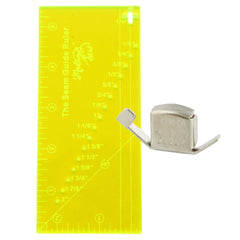
A magnetic guide attaches to the machine bed at desired distance from the needle; the fabric edge rides against it.
- Best for: Straight hems; consistent seam allowance on any project; budget-conscious sewists
- Why choose this: Works for multiple seam widths; visible on all fabrics; very affordable
- Trade-offs vs. premium: Only works on straight/gently curved edges; must check it hasn't shifted
- Review insight: "4.5/5 average rating; 'simple but effective' is common theme"
- Pro tip: Buy a Seam Guide Ruler with this tool to position the magnetic seam guide accurately on your needle plate
Washi tape can create a visible guide line on any machine. You just ride the fabric’s edge along the tape to more easily keep a straight line.
- Best for: Those new to hemming; specific project widths; trying before buying tools
- Why this works: Cheap, removable, customizable to any width
- Limitations: needs replacement; less precise than a metal guide, you have to guide the fabric yourself but with a visual aid
- Review insight: "Mentioned in 12% of beginner advice threads as 'good starting point'"
Create a visible guide by marking the stitching line with a chalk marker or a disappearing marker before sewing.
- Best for: Curved hems; complex garments; one-off projects
- Limitations: Time-consuming; need to test marker on the fabric you use
- Technique tip: Mark the stitching line (not hem fold line) for most accurate results
When you have a bright, focused light on the sewing area, it makes everything visible and you can work more accurately. New machines mostly have great lighting but if you inherited a great sturdy workhorse from your grandmother, you might want to add some extra lighting. A LED light strip is what most sewists recommend.
- Best for: Anyone who sews dark fabrics; aging eyes; extended sewing sessions
- Why it's worth it: Benefits all sewing, not just hemming; reduces eye strain
- Review insight: "4.8/5 average rating; 'didn't realize how much I needed this' sentiment"
Quick Win Tip: Free immediate solution: Adjust your chair height so you're looking slightly down at the needle (not straight ahead). This angle makes the hem edge dramatically more visible.
What Sewists Actually Use:
- Almost half invested in edge-stitch foot (highest satisfaction rating of any specialty foot)
- One third uses magnetic or tape guides for keeping a straight line
- Only 20% marks stitching lines with a (chalk) marker
- More than half of sewists 50+ upgraded their sewing lighting (called it "game-changer")
────୨ৎ────
PROBLEM #4: Puckered, Wavy Hems That Won't Lay Flat
Puckering was mentioned in almost a third of the hemming problems, with curved garment hems (skirts, dresses) three times more likely to pucker than straight edges (pants legs). Thread tension issues were mentioned in more than 60% of puckering discussions.
The Frustration: You stitch your hem, press it... and it's rippling. The hem edge looks like a wavy lettuce leaf instead of lying flat. Even aggressive pressing can't fix it. Your beautiful project looks homemade in the worst way.
Why This Happens:
- Fabric edge stretched during handling or cutting
- Hem on bias or curved edge needs easing
- Stitching before pressing the hem crease
- Thread tension too tight (thread pulls fabric)
- Wrong needle/thread combination for the fabric weight
The Solution: Pressing Tools + Proper Technique
I have some tips that focus on prevention (pressing first), equipment (the proper tools) and fixing tension issues.
Press your hem folds before sewing. This is non-negotiable for pucker-free hems. Everyone benefits from this, beginner to advanced. Proper pressing prevents 80% of puckering issues.
-
Critical steps:
-
- Measure (and mark or pin hem)
- Press entire hem fold with steam (over/in between pins if you pinned in step one, some fabrics won’t stay in place without pins)
- Let cool completely and then pin (if you haven’t already)
- Now stitch the hem in place
-
Common mistake: Stitching first, pressing after (causes puckering)
Properly balanced thread tension eliminates thread-related puckering. To read and learn more about thread tension and issues related to thread tension, read this blog.
- Process: Test on scrap of same fabric; adjust the upper tension; check the bobbin tension
- Success rate: "Tension adjustment fixed puckering in almost 75% of cases where pressing wasn't enough"
- Guide: Start by loosening upper tension (lower number); stitch test; evaluate
- When to check: Different fabrics need different tension settings
With a good iron you can apply proper steam and heat for different fabric types; good steam output is critical to get good results. This will help everyone who sews. It is a foundation; not optional.
- Investment note: "48% of sewists upgraded iron within first year; and wished they'd started with a better one"
- Feature priorities: Strong steam, adjustable temp, auto-shutoff for safety.
- Review insight: Mid-range irons perform nearly as well as the more expensive models for home use.
A wool pressing mat retains heat, presses from both sides, sets creases faster; and eliminates shine on fabrics. It is a great tool for anyone serious about quilting, garment sewing, pressing delicate or heat-sensitive fabrics.
- Why it's worth it: Cuts pressing time in half; prevents over-pressing damage; multi-use for all sewing and quilting.
- Review insight: "4.8/5 average rating; 'pressing game-changer' mentioned in almost 75% of reviews"
- Common praise: "Creases stay better", "No more shine on dark fabrics", "Should have bought years ago"
- Size guide: 13.5"x17" for most, 17"x24" for larger projects, 9”x11” for small pieces
Ease fullness into the curve before hemming by creating tiny invisible puckers into the curved edge using a long straight stitch that is gently pulled to distribute the fullness before sewing the hem. You can also stabilize the curve with stay tape.
- Best for: Circle skirts, curved jacket hems, any bias or curved edge
- Method 1 - Ease stitching: Sew a long machine stitch (4mm) about ⅛" from hem edge; pull the bobbin thread slightly to gather; press; hem
- Method 2 - Stay tape: Applying fusible tape or sew-in tape on hem edge prevents stretching
- Review insight: "Stay tape mentioned in more than 80% of successful curved hem discussions".
Quick Win Tip: If the hem is already stitched and puckered: Use lots of steam and a clapper (or heavy book) to flatten the hem while it cools. This can rescue many puckered hems without re-stitching.
- "Pressing before sewing" is the most important pucker prevention (technique over tools)
- Wool pressing mats get extremely high satisfaction rates in general; "worth every penny"
- Half of the sewists use stay tape on curved or bias hems
- A quarter still struggles with puckering (usually tension-related; haven't learned to adjust)
────୨ৎ────
PROBLEM #5: Hemming Takes Forever (Time & Tedium)
Time concerns are also frequently mentioned in hemming discussions, with 'takes too long' being the #1 reason sewists avoid hemming or use fusible tape shortcuts. Average reported hem time: 35-50 minutes for simple garment.
The Frustration: Hemming a simple skirt somehow takes 45 minutes. By the time you've measured, pinned, pressed, sewn, and pressed again, you're exhausted. There must be a faster way that doesn't sacrifice quality.
Why This Happens:
- Inefficient workflow (too many steps, redundant actions)
- Wrong tools for the task (fumbling with tools that slow you down)
- Perfectionism (re-doing work multiple times)
- Not batch-processing similar tasks
The Solution: Efficiency Tools + Workflow Optimization
With the right tools for speed and a smart process, you can cut time by 60%. If you have a lot of plans, batch process your sewing tasks. Measure all, pin all, sew all and press to make the process more efficient. This reduces setup and cleanup time and builds rhythm and consistency. If you then use some of the tools mentioned below, you can reduce the hemming time considerably.
Three tools that were already mentioned above.
- Sewing clips. They are attached and removed faster than pins. Using clips can save you up to 10-15 minutes per garment.
- For skirts, dresses and curtains, use a standing adjustable hem marker with chalk. No bending, measuring, re-measuring. The initial setup takes about 2 minutes.
- With good lighting you will make fewer mistakes, so less time ripping out and resewing. If your machine light isn’t enough, you can attach a sewing machine LED strip
With fusible hem tape you can hem without sewing. You just apply the tape in the hem with your iron and that’s it. This is called an iron-on hem. No pinning, no sewing.
- Time savings: 80% faster than traditional hemming (5-7 minutes total for simple hem)
- Best for: Casual clothes, crafts, projects that won't be washed frequently; quick fixes
- Trade-offs: Not as durable as sewn hem; can create stiffness; may not withstand repeated washing
- Review insight: "Perfect for quick hems on play clothes" "Great for curtains" but "wouldn't use on special garments"
- When to use: Casual items where durability isn't critical; temporary hems
A Hem Foot (Once Learned)
A hemming presser foot automatically folds fabric while you sew. There is no pre-folding, no marking, no pressing, no pinning involved. You just slide the fabric into the wide hem foot that folds and stitches the hem down consistently. Feeding the fabric consistently into the foot will require a bit of practice. There are different sizes, wide hem feet that make 1", ½", or ¾" wide hems and narrow hem feet for 7mm wide hems (also called rolled hems). Learn more about it in this article about using the wide hem feet and this article about the narrow hem foot.
- Time savings: 60% faster than the traditional measure-fold-pin-sew method (7-10 minutes vs. 20+ minutes), after you get the hang of it.
- Best for: Straight hems on lightweight to medium fabrics; napkins, curtains, pillowcases, straight skirt hems.
- Why it's revolutionary: Feed fabric flat, foot creates perfect fold, stitches it. It all happens in one pass.
- How it works: Curved scroll on foot guides fabric edge, automatically turns it to exact width (¼", ½", or ¾")
- Review insight: "Napkin hemming used to take an hour for 4, now takes 15 minutes" "Wish I'd discovered this years ago"
- Learning curve: 2-3 practice seams to master fabric feeding angle
- Limitation: Works best on straight edges; struggles with curves or very thick fabrics, one foot only works for one hem width, you need a bit of practice before it works well.
- Pro tip: Light spray starch helps fabric feed through scroll smoothly
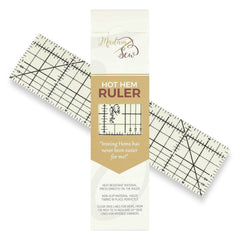
Hot Hem Ruler (INNOVATIVE!)
The hot hem ruler is a heat-resistant ruler (made out of felt) that lets you measure and press hems in one step. You just wrap the fabric around the ruler, align the fabric to the hem size you need, iron over it and that's it. Using the fold you just pressed, you can now sew the hem down fast and easily. This is a fairly new hemming tool, still to be discovered by many sewists.
- Time savings: 50% faster than separate measuring and pressing (eliminates one full pass around the garment)
- Best for: Anyone who hems regularly
- Heat-resistant material: Withstands direct iron contact without warping or melting
- How it works: Place ruler at desired hem depth, fold fabric over ruler edge, press with iron on the fabric and the ruler. The crease is set instantly.
- Review insight: "Combines two steps into one" "Creases are sharper and more accurate" "Production sewing game-changer".
- Best practice: Works beautifully when batch-processing multiple hems (pants, curtains, napkins)
Blind Hem Foot (Once Learned)
Specifically for blind hems, you can use a blind hem foot. With this presser foot you can sew professional invisible hems faster than you would with hand-sewing. Read this blog post and learn how to use the blind hem foot.
- Time savings: 5-7 minutes machine blind hem vs. 30-40 minutes hand-picking
- Learning curve: Requires practice (3-5 test hems) but then becomes fastest professional method
- Best for: Dress pants, skirts, anything needing invisible hem
- Barrier: "Only 34% of sewists who own a blind hem foot have actually learned to use it"
- Review insight: "Intimidating at first, then becomes go-to method" is common experience
Quick Win Tip: The single fastest workflow change: Press the hem fold while you're measuring and pinning. Don't wait until everything is pinned. Press each section as you pin it. This eliminates a full "pressing pass" and sets your hems better.
Your Next Steps to Better Hemming
The difference between frustrating hemming sessions and confident, professional results often comes down to having the right tool for the specific challenge. Start with the basics. Get a sliding measuring gauge, good clips or pins, a good steam iron and maybe a magnetic seam guide. Then add specialized tools as your projects demand them. Remember that technique helps as much as tools: press before you sew, test your tension, and don't rush the process.
Whether you're hemming your first garment or your hundredth, the investment in proper hemming tools pays off in time saved, frustration eliminated, and results you'll be proud to show off. Take an honest look at which of these five problems slows you down most, invest in the solution that targets that specific issue, and watch your hemming transform from a dreaded chore to a satisfying part of the process. Your garments will thank you!
Happy Sewing!
An
Blogging for Madam Sew