What Does Your Sewing Machine Need for Quilting or Sewing Clothes?
PART 3: Quilting vs. Garment Sewing: Sewing Machines
What sewing machine do you need for quilting? Is it the same machine as the one sewists use to make clothes? Many of us use the same sewing machine for both quilting and garment sewing. But what we ask of that machine and the accessories we attach to it, can be very different.
This is Part 3 of our series comparing the quilting and garment sewing toolkit. In this post we look at what your sewing machine needs to be capable of for each craft: stitches, machine functions, throat space, power, presser feet, threads, and needles. This way you can get more from the machine you already have, or make a more informed choice if you're considering an upgrade.
Missed Parts 1 and 2? Catch up here: Part 1: Cutting Tools for Sewing Clothes Versus the Tools for Quilting and Part 2 Measuring & Marking Tools for Sewing versus Quilting.
What Quilters Need from a Machine
Quilting is a machine-intensive craft, and it puts a very specific and focused set of demands on your machine. You don't need a machine that does everything. You need one that does a few things exceptionally well. It has to do its job consistently, repeatedly, and over long sessions. Here is what matters.
Stitches
For quilting, you mostly use a straight stitch. That's it, no stretch stitches or overlock stitches needed and the zigzag stitch used occasionally to quilt instead of stitch-in-the-ditch or in a decorative way. Quilters are almost entirely straight-stitch sewists during the piecing phase. This is for the construction of the quilt top. During quilting the quilt sandwich, you can either sew straight lines or free-motion stitch different shapes with a straight stitch but in this phase also different decorative stitches are often used. These stitches are both decorative and for construction, so they need to be strong but also consistent and good looking.
For piecing, most quilters work with a stitch length of around 2.0 to 2.5mm. Short enough to create seams that hold up well over years of washing and use, but not so tight that every seam rip becomes a small disaster. For quilting the quilt sandwich, a slightly longer stitch works better, typically between 2.5 and 3.5mm, giving the thread more room to work through the layers of top, batting and backing without puckering.
In general, the workhorse for quilting is the straight stitch. The stitch length itself doesn’t affect which machine you need for quilting. Virtually all sewing machines, including basic entry-level models, offer a stitch length range of 0 to 5mm or more, which covers everything a quilter needs across all phases. It is not a specification you need to chase. What does matter is whether you can adjust it quickly and precisely. A machine with a clear digital display and easy stitch length controls makes switching between piecing and quilting phase settings much smoother than fiddling with a knob mid-project.
Machine Functions
The needle-down function is another feature that matters more for quilting than for garment sewing. It keeps the needle in the fabric when you stop sewing, which is invaluable when you need to pivot at the corner of a quilt block, reposition your hands, or adjust the fabric mid-seam without losing your place. Garment sewists do appreciate it too, but they tend to reach for it less often since garment seams are longer and involve fewer tight pivots. For quilters, it quickly becomes one of those features you cannot imagine working without. On my Brother it is the top button you see in the picture below.
For free-motion quilting, the machine setting doesn't actually control your stitch length. You control the stitch length, through the combination of your machine speed and how fast you move the fabric. But in order to do so you have to be able to deactivate the feed dogs that move the fabric forward to create a specific stitch length. These are the little teeth on the machine bed right under the needle.
Not every sewing machine has a drop feed dogs function. Most modern machines do, usually via a small lever or button on the back or side of the machine, but some basic entry-level machines and many older machines do not. In the image below you can see the slider on my Pfaff sewing machine. It is hidden in the back. You can only see it when you remove the extension table.
If you want to do free-motion quilting, this is something to specifically check before you buy. A machine without the ability to drop or disengage the feed dogs can still be used for free-motion quilting by setting the stitch length to zero, which stops the feed dogs from actively moving fabric forward, or by covering them with a special cover plate if one came with the machine. It works, but it is a workaround rather than the intended function, and the results can vary. If free-motion quilting is part of your plan, look for a machine that explicitly mentions droppable feed dogs in its specifications.
Throat Space and Machine Bed
Throat space is also important when quilting. It is the distance between the needle and the body of the machine. When you're quilting a large quilt sandwich you need enough room to maneuver your fabric under the machine to stitch in the right spot. This is why some quilters invest in machines with larger throat spaces, extended work surfaces, or ultimately dream of a longarm quilting machine. Only the happy few have the budget and the space to own one of those.
A standard sewing machine typically offers around 6 to 7 inches of throat space vertically and horizontally. Machines designed with quilters in mind can offer anywhere from 9 to 11 inches, giving you noticeably more room to guide a larger quilt sandwich without it bunching up against the body of the machine.
An extended work surface (sometimes called an extension table) clips or slides onto your machine to create a larger flat sewing area around the needle. It supports the weight of the quilt sandwich as you sew, preventing the fabric from dragging and pulling unevenly under the needle. Both things, more throat space and a larger work surface, make a real difference once your projects grow in size.
A longarm quilting machine is a specialized machine with a very long arm (typically 18 to 30 or more inches of throat space) mounted on a large frame that holds the quilt sandwich taut. Rather than moving the fabric under the machine as you do on a regular sewing machine, you move the machine head across the fabric. This makes it much easier to quilt large projects smoothly and evenly, and it opens up a whole world of quilting designs. It is a dream tool, but it requires significant investment in both budget and space.
Sewing Machine Power
The motor power of a sewing machine matters more in quilting than people often expect. Quilting through three layers of fabric and batting puts more load on the machine than regular garment sewing. A stronger motor means more consistent stitch quality at lower speeds, less strain on the machine over long sessions, and better performance when guiding bulky quilt sandwiches. If you quilt regularly, it is worth looking at the specifications of your machine and considering whether a more powerful model might serve you better in the long run.
Motor power in sewing machines is expressed in watts, and you can find it on the label on the back of your machine. If it only shows volts and amps, multiply the two and you have the wattage. A basic home sewing machine typically runs around 70 to 90 watts. Machines aimed at quilters or heavier use generally sit at 90 watts and above, which is what you want when you're regularly pushing thick quilt sandwiches through the machine. Below 70 watts and you may notice the machine struggling to maintain consistent stitch quality under load.
That said, wattage alone does not tell you everything. The internal build of the machine matters just as much. A machine with metal internal gears and a solid drive train will outperform a higher-wattage machine with plastic gears every time, especially over long quilting sessions. The real-world test is this: can the machine sew slowly through multiple layers of fabric and batting without losing torque, skipping stitches, or making a strained sound? That ability to maintain power at low speed is what actually matters for quilting. When you're in a shop testing a machine, bring a folded scrap of quilting cotton with a layer of batting and run it through at a slow, controlled speed. That tells you more than any spec sheet.
Sewing Machine Accessories
To upgrade the capabilities of a sewing machine or the professionalism of the sewing results, quilters use different presser feet. These include mainly the ¼" quilting foot, the walking foot, the darning foot, and a stitch-in-the-ditch foot.
The ¼" quilting foot has a guide on the right side that sits exactly at the ¼" mark from the needle, so you can run your fabric edge against it and sew a perfectly consistent seam every single time without having to watch the needle or the markings on your machine bed. Even being a thread or two off can cause blocks to not line up correctly across a large quilt top, so this foot earns its place immediately.
The walking foot (or even-feed foot) solves one of the most common quilting problems: when you sew through the quilt sandwich (top, batting and backing), a regular presser foot only feeds the bottom layer with the feed dogs, which causes the upper layers to creep forward and create puckers or tucks on the back of your quilt. A walking foot has its own set of feed dogs built in, so it grips and feeds all layers evenly at the same time. It is also excellent for matching stripes and plaids.
The darning foot (or free-motion foot) is what you use when you want to stitch curves, loops, feathers, stippling or any free motion design across your quilt. You drop or cover the feed dogs so they no longer move the fabric automatically, and then you move the quilt sandwich yourself in any direction under the needle. The darning foot has a spring mechanism that holds the fabric down only at the moment the needle enters it, then lifts so you can move freely. It takes some practice to build up a rhythm, but it is one of the most creative and satisfying things you can do on a regular sewing machine.
The stitch-in-the-ditch foot has a small blade or guide in the center that sits right in the seam line (the "ditch") and keeps your stitching running directly on top of the ditch. Because the stitches land in the existing seam, they sink in and become nearly invisible from the front of the quilt. It is a clean, quiet way to anchor your quilting without it competing visually with your piecing.
Threads
Thread choice for quilters leans heavily toward 50-weight cotton thread for piecing (it's thin enough to keep seams flat and accurate) and a variety of weights and types for the quilting phase — from invisible monofilament to bold 40-weight or even 12-weight cotton for decorative quilting. More about thread choice for quilting in this blog about thread weight and this one about choosing the right thread for quilting.
Needles
Needle choice for quilting is more straightforward than for garment sewing, but it still matters. For piecing quilting cotton, you can use a universal needle in sizes 12/80 or 14/90. They handle medium-weight woven fabrics well. When you move into the quilting phase and start working with decorative or heavier threads, your needle needs to follow. A thicker thread needs a larger needle eye and a bigger size to prevent the thread from shredding or breaking. And whatever needle you're using, change it regularly. A blunt needle is one of the most common causes of skipped stitches, thread tension problems, and that tell-tale thudding sound the machine makes when the needle forces its way through the fabric instead of piercing it cleanly. A good rule of thumb is a fresh needle for every new project. For a full overview of needle types, sizes and which fabric calls for which needle, read our Sewing Machine Needle Basics guide.
What Garment Sewists Need from a Machine
Quilting asks your sewing machine to do one thing very well for a long time, sewing clothes asks it to do many things reliably: Different stitches, different fabrics, different techniques, sometimes all in the same project.
Stitches
Garment sewing asks much more of a machine in terms of stitch variety than quilting does. A straight stitch is still your most-used stitch, but it is far from the only one you need. A good zigzag stitch is essential for finishing seam allowances on woven fabrics and for sewing seams on stretch fabrics. A buttonhole function is something you will reach for on almost every garment project. A blind hem stitch handles invisible hemming on trousers and skirts. For knit fabrics, a stretch stitch or lightning bolt stitch keeps the seam from snapping when the fabric stretches. The more varied your projects, the more you will appreciate a machine that handles all of these reliably.
Stitch width matters in garment sewing in a way it does not for quilting. Zigzag width determines how well you finish a seam allowance or how securely you sew a knit seam. A machine that offers adjustable stitch width gives you significantly more control over the result.
Stitch length for garment sewing is not fixed to a narrow range the way it is in quilting. For standard woven fabrics, 2.5mm is a solid default for constructing seams. Basting stitches run longer, around 4 to 5mm, so they pull out easily. Topstitching often looks better with a slightly longer stitch, around 3 to 3.5mm, because the individual stitches become part of the visual detail of the garment. On stretch fabrics, a longer stitch also reduces the risk of puckering. As with quilting, stitch length range is not a specification to worry about when buying a machine. All modern machines cover what you need. What matters more is whether the machine produces a clean, consistent stitch at the length you set, across different fabric weights.
Stitch quality in garment sewing shows up differently than in quilting. In a quilt, most stitching is hidden in seams or functional. In a garment, your topstitching is visible, your buttonholes are on display, and a puckered seam on the front of a blouse is impossible to ignore. A machine with good tension calibration and consistent stitch formation produces results that look professional. When testing a machine in a shop, bring a piece of your typical fabric and sew a seam, a zigzag edge finish, and a short line of topstitching. That combination tells you a lot about how the machine actually performs on garment work.
Machine Functions
The buttonhole function deserves attention when choosing a machine for garment sewing. Basic machines offer a four-step buttonhole, where you manually move through each step of the buttonhole sequence. Better machines offer a one-step automatic buttonhole, where the machine senses the button size and sews the entire buttonhole in one go. If you sew garments regularly, a one-step automatic buttonhole saves time and produces more consistent results, especially when you have a row of buttons to work through. Below are some examples of button hole setting from different sewing machine brands.
Adjustable presser foot pressure is a function that garment sewists appreciate more than quilters. Different fabrics need different amounts of pressure from the presser foot to feed correctly. Too much pressure on a delicate silk can distort the fabric. Too little on a heavy canvas and the fabric slips and skips. A machine that lets you adjust presser foot pressure gives you much better control across the range of fabrics garment sewing involves.
A free arm (or a very narrow arm) is another feature that matters more for garment sewing than for quilting. It is the narrow cylindrical part of the machine bed revealed when you remove the extension table, and it allows you to slide a sleeve, a trouser leg, or a cuff onto the machine to sew it in the round. Without a free arm, hemming sleeves or sewing cuffs becomes a much more awkward process.
The needle-down function is useful in garment sewing, though you reach for it less instinctively than quilters do. It earns its place when topstitching around curves, inserting zippers, or sewing any section where you need to stop, reposition, and continue without losing your line.
Throat Space and Machine Bed
Throat space matters less in garment sewing than it does in quilting. Garment pattern pieces are smaller and more manageable than a full quilt sandwich, and you are rarely fighting bulk under the arm of the machine in the same way. A standard 6 to 7 inch throat space is perfectly adequate for most garment work.
What does matter more in garment sewing is the free arm, as mentioned above, and a stable, flat extension table for cutting and laying out pattern pieces. Many garment sewists also benefit from a larger work surface behind and to the left of the machine to support fabric that would otherwise drag and distort as it feeds through.
Sewing Machine Power
Garment sewing generally puts less sustained load on a machine than quilting through batting does. Most garment fabrics, even medium-weight wovens, feed through without straining the motor. That said, there are situations where power matters. Sewing through multiple seam allowances at intersections (think of the crotch seam of a pair of jeans where four or more layers of denim meet) puts real strain on a machine. Canvas, upholstery fabric, and heavy coating fabric do too. If your garment sewing regularly involves heavy materials or thick layers, the same logic applies as in quilting: look for a machine rated at 90 watts or above with metal internal components. For lighter garment fabrics, a standard home machine handles the work without difficulty.
Sewing Machine Accessories
Garment sewing generally puts less sustained load on a machine than quilting through batting does. Most garment fabrics, even medium-weight wovens, feed through without straining the motor. That said, there are situations where power matters. Sewing through multiple seam allowances at intersections (think of the crotch seam of a pair of jeans where four or more layers of denim meet) puts real strain on a machine. Canvas, upholstery fabric, and heavy coating fabric do too. If your garment sewing regularly involves heavy materials or thick layers, the same logic applies as in quilting: look for a machine rated at 90 watts or above with metal internal components. For lighter garment fabrics, a standard home machine handles the work without difficulty.
Sewing Machine Accessories
Garment sewists rely on a wider range of presser feet than quilters do, because garment construction involves more varied techniques. The feet you reach for most often include the regular zipper foot, the invisible zipper foot, the buttonhole foot, the blind hem foot, the overcast foot, the rolled hem foot, and for tricky fabrics like vinyl or leather, a teflon foot or roller foot.
- The regular zipper foot (8) is a narrow foot that lets you sew close to the zipper teeth on either side. You use it for standard zip installations, for piping, and for any situation where you need to stitch right up against a raised edge.
- The invisible zipper foot (9) has two grooves on the underside that roll the zipper coil open as you sew, allowing you to stitch right to the base of the coil. The result is a zipper that is completely hidden in the seam. It looks far more polished than a standard zip installation and is worth learning early.
- The buttonhole foot (3) holds the button in a small compartment at the back, allowing the machine to automatically size the buttonhole to match. On machines with a one-step automatic buttonhole function, this foot is what makes it work. With a button foot (4) you can sew buttons onto garments with a sewing machine.
- The blind hem foot (1) guides your fabric so that the machine catches only a single thread of the folded fabric with each stitch, producing a hem that is nearly invisible from the right side of the garment. It takes a little practice to set up correctly, but once you have it, hemming trousers and skirts becomes much faster.
- The overcast foot (5), also called an overedge foot, has a small pin or bar over which the thread loops as you sew a zigzag or overcast stitch, finishing the raw edge cleanly without a serger. It does not replace a serger, but it does a respectable job on most woven fabrics.
- The rolled hem foot (2) folds a narrow double hem as you feed the fabric through, producing a tiny, clean hem along the edge. It works beautifully on lightweight fabrics like chiffon, silk, and linen, and is the fastest way to hem a long skirt or wide sleeve edge cleanly.
- The teflon foot (7) and roller foot (6) both solve the same problem from different angles: they allow fabric that would otherwise stick to a standard metal presser foot (vinyl, leather, faux leather, laminated cotton) to glide through the machine smoothly.
Other Machines
Beyond the main machine, many garment sewists invest in a serger (overlocker). A serger trims, wraps, and stitches the seam allowance in one pass, producing the kind of neat, professional edge finish you see inside ready-to-wear garments. It also sews stretch seams more reliably than a standard sewing machine for most knit fabrics. A serger is a significant addition to a garment sewing setup and has almost no application in quilting.
Some garment sewists, particularly those who work a lot with knit fabrics, also add a coverstitch machine. A coverstitch produces a triple parallel row of stitches on the right side of a hem and a looped stitch on the wrong side, exactly like the hem on a commercial t-shirt. It is a specialist machine for a specific task, but for anyone who sews knit garments regularly, it removes the one frustrating limitation of a standard machine setup.
Threads
Thread choice for garment sewing is broader than for quilting. All-purpose polyester thread handles most garment construction well, with enough strength and slight stretch to suit both wovens and knits. For visible topstitching, a dedicated topstitching thread in a heavier weight (around 30 or 40 weight) gives a cleaner, more defined look.
Needles
Needle choice is far more varied for garment sewing than for quilting. Each fabric type has a needle designed for it, and using the wrong one is one of the most common causes of skipped stitches, thread breaks, and fabric damage. Universal needles handle most medium-weight wovens well, but as soon as you move to knits, stretch fabrics, silk, denim, leather, or microfiber, a specific needle makes a real difference. Ballpoint and stretch needles for knits, microtex for fine wovens and silk, denim needles for heavy denim and canvas, and twin needles for coverstitch-style hems on a standard machine are all part of a garment sewist's regular rotation. For a full overview of needle types and sizes, read our Sewing Machine Needle Basics guide.
Where Garment Sewing and Quilting Overlap
Both quilters and garment sewists benefit from a well-maintained machine with consistent tension, a reliable straight stitch, and good stitch quality across different fabric weights. A speed control slider is appreciated on both sides. Quilters use it to maintain control over long seams and intricate free-motion work, garment sewists for topstitching curves and sewing slowly through thick seam intersections. An automatic thread cutter is a small feature that both quickly wonder how they lived without.
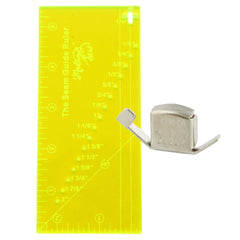
The magnetic seam guide is another crossover tool that earns its place at any machine, whether you're piecing quilt blocks or sewing a straight hem on a pair of trousers. It clips to the machine bed and gives your fabric a physical edge to run against, which helps maintain a consistent seam allowance without having to watch the markings constantly.
Needle maintenance applies equally to both crafts. Use a fresh needle at the start of a project, the right type for the fabric, and change it as soon as stitches start skipping or the machine begins struggling through the fabric. So is the recommendation to clean lint from around the feed dogs regularly and oil the machine according to the manufacturer's instructions. A well-serviced machine performs better and more consistently, whatever you're making. I’ve written another blog post about sewing machine maintenance if you need more information on this topic.
And both quilters and garment sewists will eventually find themselves wanting more: more throat space, more power, more feet, a second machine dedicated to a specific task. That is less a sign of a problem and more a sign that the craft has taken hold.
Conclusion
So can you use the same sewing machine for quilting and sewing clothes? In most cases, yes. The quilter and the garment sewist sitting at the same machine will have different wish lists. The quilter wants throat space, a needle-down function, droppable feed dogs, and a walking foot; the person sewing clothes wants stitch variety, a one-step buttonhole, a free arm, and an invisible zipper foot. But most of these features coexist comfortably in a good mid-range machine. What really sets a quilting setup apart from a garment sewing setup is less about the machine itself and more about the accessories around it. The presser feet you add, the thread you choose, the needles you keep in rotation. That's where the two crafts diverge, and that's where you can build from. Start with the machine that serves your main craft well, and add from there as your projects grow.
In Part 4, we look at something both crafts depend on more than most people expect: the ironing setup and pressing tools that make or break your results. And if you missed the earlier parts of this series, start from the beginning with cutting tools for quilting and sewing clothes, and measuring and marking tools for quilting and sewing clothes.
Happy sewing and quilting!
An
Blogging for MadamSew